

February 26, 2026
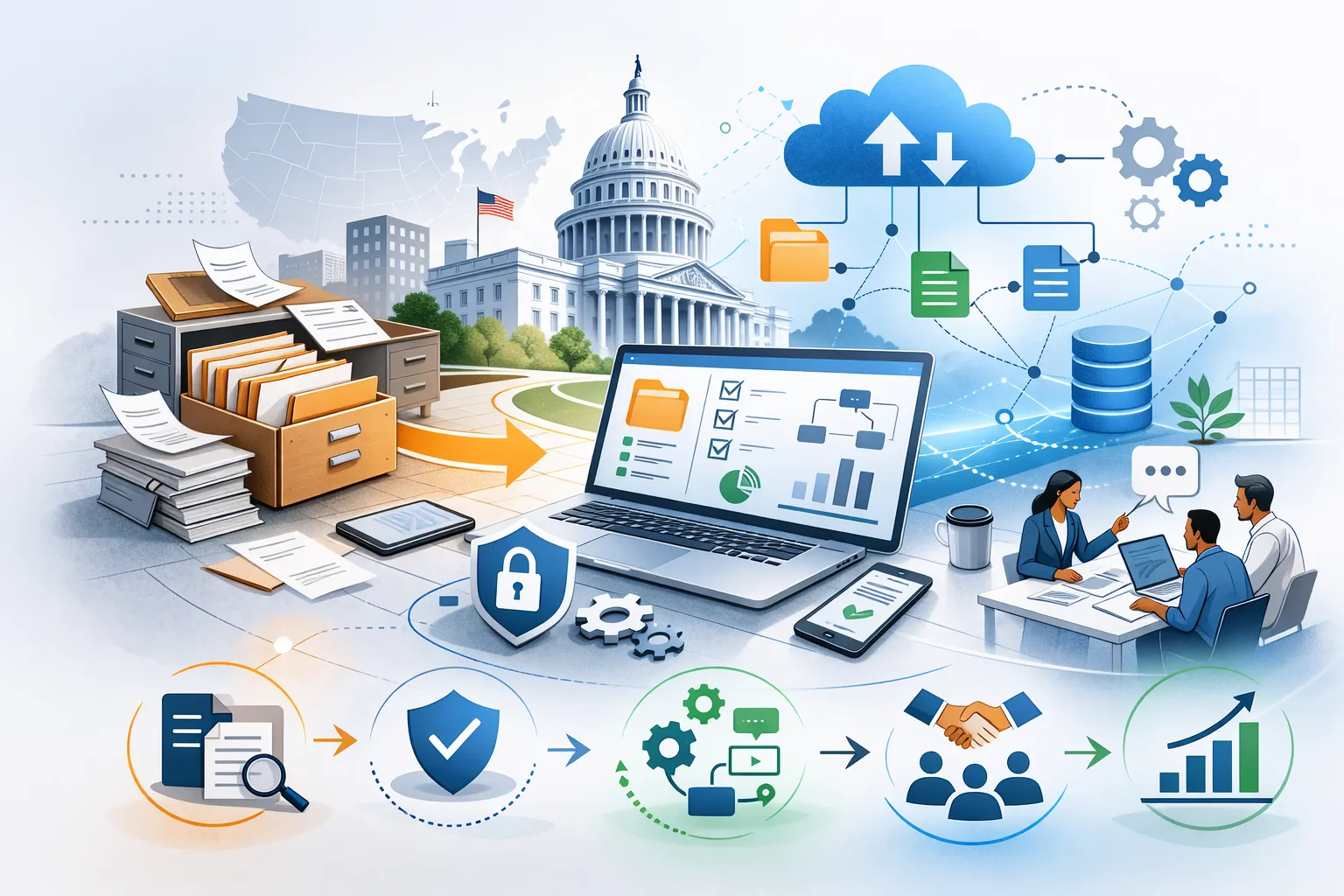
Unsupported ECM systems are failing under the weight of modern governance demands. Here's how forward-thinking state CIOs are rebuilding for the next decade.
The folders haven't changed. The paper forms may have been digitized, but in many state agencies, the underlying logic (documents stored in isolation, retrieved by institutional memory, approved through email chains) remains stubbornly analog in its DNA. Enterprise Content Management (ECM) modernization is no longer a nice-to-have on a five-year roadmap. It is the connective tissue without which every other digital transformation initiative frays.
State IT leaders face a unique challenge that their private-sector peers largely do not: they are accountable to the public, bound by records retention mandates, constrained by procurement rules, and operating systems that have accumulated decades of customization, integration debt, and political inertia. Modernizing ECM in this environment requires a strategy that is equal parts technical, organizational, and political.
The question is no longer whether to modernize your unsupported ECM platform, it's whether you modernize it on your terms or wait until a compliance failure or a system outage forces the decision for you.
Most state governments built their document management infrastructure in the early-to-mid 2000s, often around on-premise platforms. These systems were designed for a world of static document repositories, not the dynamic, API-connected, mobile-accessible environment that modern government operations require.
The risks are no longer hypothetical. Over the past three years, legacy ECM failures have contributed to delayed emergency permitting, missed records requests under sunshine laws, audit findings related to inconsistent records retention, and security vulnerabilities tied to unpatched on-premise infrastructure. In at least two states, major ECM outages directly impacted benefits processing, with real consequences for residents. It’s imperative that State governments need a dedicated and trusted support Partner to manage their legacy platforms to ensure the system is always up to date and performing.
Federal mandates are cascading requirements down to state agencies that interact with federal programs. States that cannot demonstrate consistent, auditable document lifecycles risk losing federal funding streams. This has elevated ECM from a back-office concern to an executive priority practically overnight.
State agencies are increasingly turning to cloud-hosted ECM platforms to reduce infrastructure overhead and improve accessibility across distributed teams. Unlike on-premises systems, cloud-based ECM for the public sector enables agencies to scale storage and user capacity without capital procurement cycles, and supports continuity of operations during emergencies or office closures.
Experienced state CIOs consistently warn against the "big bang" ECM replacement or a full-platform swap in a single initiative. The complexity of migrating decades of records, re-training thousands of state employees, and integrating with dozens of upstream and downstream systems makes this approach extraordinarily high-risk. Instead, a phased modernization framework has emerged as the dominant model.
Before evaluating vendors or issuing an RFP, state IT leaders need a clear picture of what they actually have. This means cataloging every content repository in the enterprise, not just the official ECM system, but the SharePoint sites, the network drives, the agency-specific databases, and the email archives that serve as de facto document management systems in many offices.
The audit should map content volumes, access patterns, retention schedules, sensitivity classifications, and integration dependencies. States that skip this step often discover mid-migration that they have far more data than anticipated, or that critical business processes are deeply entangled with legacy system quirks that no one has documented.
Records retention is the area where legacy ECM creates the most acute legal and compliance risk for state governments. Retention schedules that exist in policy documents but are not enforced in systems create exposure under public records laws and generate audit findings. Modern ECM modernization should treat automated retention policy enforcement as a baseline capability, not a future phase.
This requires investing in records classification, ideally augmented by machine learning tools that can auto-classify documents based on content and context, and ensuring that retention policies are applied at the point of capture rather than through periodic cleanup campaigns. States that have implemented automated disposition workflows report dramatic reductions in storage costs and legal hold complexity.
The most persistent complaint about ECM in state government is that documents live in a silo, disconnected from the case management systems where work actually happens, or from the ERP platforms that drive financial and HR transactions. Modern ECM modernization must treat integration not as a future project but as a first-order design requirement.
State IT leaders should require bidirectional integration between ECM platforms and their major line-of-business systems, Salesforce Government Cloud, Tyler Technologies' platforms, SAP, Workday, and others, so that documents are surfaced in context, within the workflow where they are needed, rather than requiring users to navigate to a separate system. REST API standards, pre-built connectors, and low-code integration platforms have made this significantly more achievable than it was five years ago.
One of the most common barriers to ECM modernization is integration with legacy systems — including ERPs, permitting platforms, and case management tools. Modern government ECM platforms address this through open APIs and pre-built connectors that allow document workflows to connect with existing IT infrastructure without requiring a full system replacement.
Public sector agencies face strict retention schedules, audit requirements, and public records obligations that commercial ECM tools aren't always designed to handle. Purpose-built government ECM platforms include records governance features such as automated retention policies, legal hold capabilities, and audit trails that satisfy both state regulations and federal compliance frameworks.
State IT leaders consistently identify change management, not technology selection or integration complexity, as the primary barrier to successful ECM modernization. State employees, many of whom have worked with the same document management workflows for a decade or more, are resistant to change not out of stubbornness but out of rational risk aversion: their current processes work, and new systems introduce uncertainty and learning curves at a time when their agency's core mission demands reliability.
Effective ECM change management in the state government context requires a few non-negotiable elements. Executive sponsorship from agency heads, not just IT leadership, signals to frontline staff that the initiative has institutional commitment. Early involvement of agency records managers and administrative staff in design and testing processes creates internal advocates who speak to their peers' real concerns. And training programs that focus on workflow changes rather than system navigation tend to drive adoption far more effectively than feature-focused instruction.
Several emerging capabilities are beginning to mature sufficiently for state IT leaders to incorporate into their modernization roadmaps.
AI-assisted content processing, including intelligent document classification, automated metadata extraction, and natural language search across unstructured content, is moving rapidly from experimental to production-ready in government-certified environments. States that augment their ECM platforms with Partners who understand AI roadmaps and authorized AI service integrations will be positioned to leverage these capabilities.
The convergence of ECM with digital process automation platforms, the blurring of lines between document management, workflow, and robotic process automation, is reshaping what "content management" means in practice. State IT leaders who think of ECM modernization as a document storage problem will miss the opportunity to build genuinely integrated, automated government service delivery infrastructure. The goal is not a better filing cabinet. It is a content-intelligent government.
Phase 0 · Content audit, stakeholder mapping, evaluation and procurement
Phase 1 · Pilot agency deployment, integration development
Phase 2 · Enterprise rollout waves, training program scale-up
Phase 3 · Advanced capability activation, continuous improvement
With over 30 years of experience, DAS offers state agencies a proven pathway to ECM modernization, from initial content architecture assessments and platform support through statewide cooperative contracts, to hands-on implementation guidance. Whether your agency is just beginning to evaluate its options or is ready to accelerate an active migration, DAS brings the expertise, established vendor relationships, and compliance frameworks to help you move faster and with greater confidence. Reach out to the DAS team to schedule a no-cost modernization readiness review and take the first step toward a content-intelligent agency.
Government ECM (Enterprise Content Management) refers to platforms and practices that state and local agencies use to capture, manage, store, and retrieve documents and records. These systems handle everything from permit applications and contracts to case files and correspondence, often with built-in compliance controls for public records laws and retention schedules.
Most agencies use a phased migration approach — starting with new content types or departments on the modern platform while legacy systems remain in place. Cloud-based ECM solutions make this easier by allowing parallel operation during transition, with cutover happening incrementally rather than all at once.


