

October 8, 2026
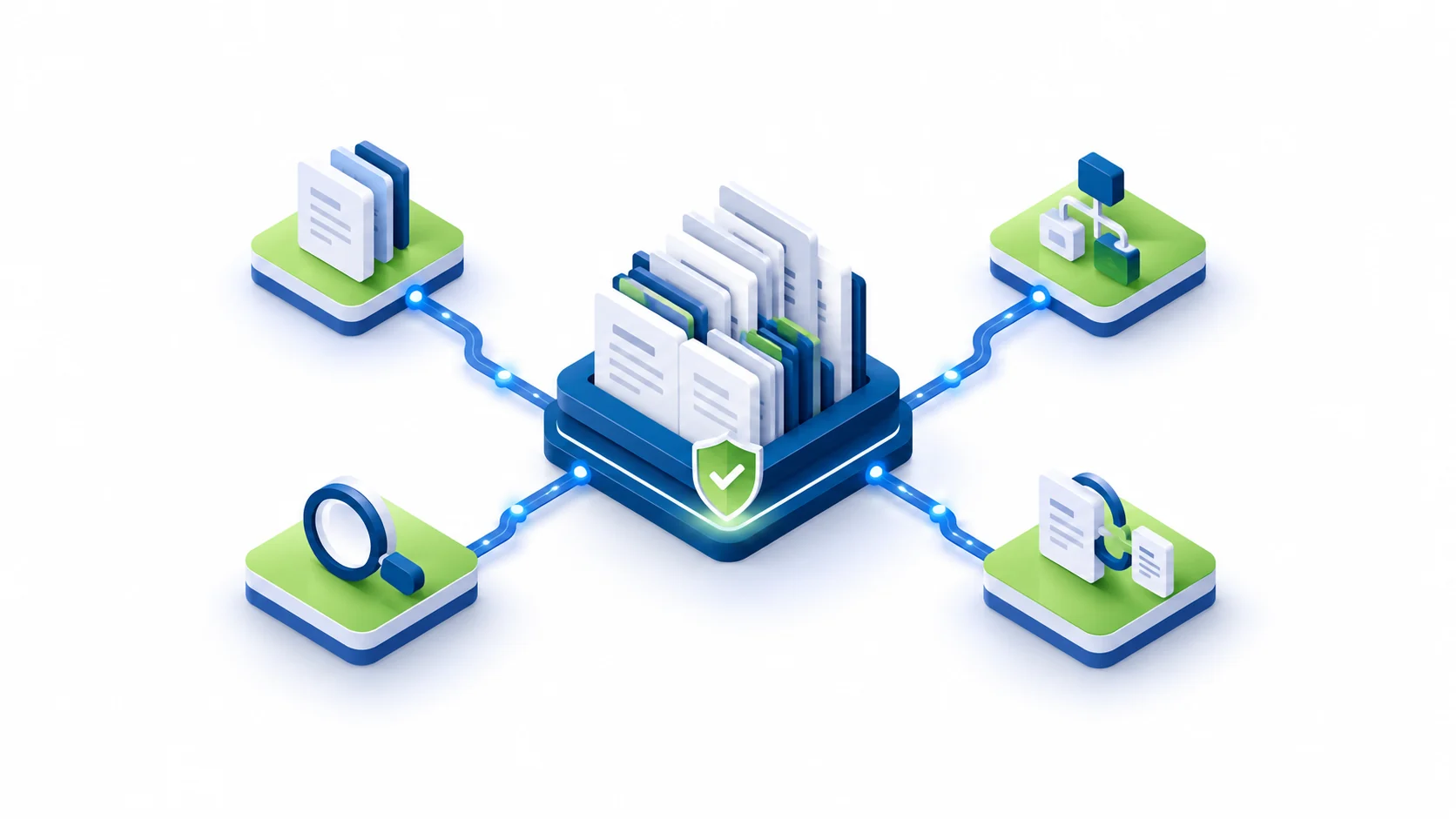
A content services platform (CSP) is a set of services, APIs, and repositories that manage enterprise content and deliver it into the applications where people actually work. Enterprise content management (ECM) usually means a single, centralized system that people log into to find and manage documents. Both handle the same core jobs: storing, securing, governing, and retrieving content. The difference is architectural. ECM asks people to come to the content. A content services platform brings the content to people, processes, and increasingly to AI agents.
If you’ve sat through vendor demos lately, you’ve probably heard both terms, sometimes used interchangeably. This guide explains where “content services” came from, what actually separates the two approaches, and how to decide which one your organization needs.
For about two decades, “enterprise content management” was the standard label for software that stored and governed business documents. Around 2016 and 2017, Gartner began moving away from the term “ECM” and reframed the market around “content services.” Its vendor evaluations shifted to “content services platforms.”
The reasoning was practical. Many ECM projects had been built as monolithic, one-size-fits-all repositories, and adoption often suffered. Employees didn’t want to leave their CRM, ERP, or email to go find a document in a separate system. The content services model reflected a shift in thinking: the value of content comes from how easily it can flow into business processes, not from where it’s stored.
Most major vendors, including IBM, Hyland, OpenText, and Laserfiche, now describe their offerings in content services terms. The underlying capabilities didn’t disappear. The emphasis changed.
There’s no single certification, but platforms described as content services generally share a few traits:
Two things are worth stating plainly. First, a content services platform is not a replacement for good content governance. It still needs a well-designed repository, metadata model, and security structure underneath. Second, many organizations running “traditional” ECM platforms like IBM FileNet already have most CSP capabilities available. What’s often missing isn’t the software. It’s the integration and architecture work to use it that way.
A content services approach usually makes sense if:
A more centralized, traditional ECM deployment can still be the right call if:
In practice, most large organizations land somewhere in between. They keep a strong central repository for governance and records, and expose that content through services to the applications and processes that need it.
IBM is a useful example because its content platform has made the ECM-to-CSP journey in public.
IBM FileNet Content Manager began as a classic enterprise repository and evolved into what IBM describes as a content services architecture. It offers APIs, container-based deployment, and integration with business automation tools. IBM Content Manager OnDemand (CMOD) handled high-volume archiving and delivery of statements and reports, and FileNet has also been delivered as part of IBM Cloud Pak for Business Automation.
In June 2026, IBM made the transition explicit with IBM Content Cortex. IBM positions it as the evolution of FileNet Content Manager, Content Manager OnDemand, and Content Manager Enterprise Edition, unified into a single AI-ready content services platform. Content Cortex supports AI-assisted document search, classification, and information extraction within the repository’s governance model. Available capabilities depend on the edition and release. It runs on-premises, in private cloud, or in public cloud.
For existing IBM customers, the important point is continuity. IBM frames Content Cortex as a phased evolution, not a rip-and-replace, and recent FileNet releases already include components that let AI agents connect to existing repositories. We cover the details in IBM Content Cortex: The Next Evolution for FileNet Customers.
Because “content services” is now a marketing term as much as a technical one, it pays to test the claim. Useful questions include:
The answers will tell you far more than whether a vendor uses the words “content services platform” in its brochure.
DAS has been implementing enterprise content systems since 1991, primarily for regulated organizations in financial services, insurance, healthcare, transportation, and the public sector. Much of that work has been on the IBM content stack, including IBM FileNet and Content Manager OnDemand.
Our view is that content services is less about buying a new platform and more about architecture. For most clients, that means:
Whether you’re running a mature ECM platform or starting fresh, the goal is the same: content that’s governed centrally and available wherever the work happens. Learn more about our IBM content services and enterprise content management practices.
Not exactly. Both manage and govern enterprise content. ECM typically refers to a centralized system users log into. A content services platform exposes content through services and APIs so it can be used inside other applications and processes.
The terminology shifted, especially after Gartner reframed the market around content services. The capabilities of ECM, such as storage, security, retention, and workflow, remain essential and are part of every content services platform.
FileNet evolved from a traditional ECM repository into a content services architecture. IBM Content Cortex, released in June 2026, is the next step: a unified, AI-ready content services platform that builds on FileNet, CMOD, and Content Manager Enterprise Edition.
Usually not. Many organizations reach a content services model by integrating and modernizing what they already have. A replacement makes sense only when the current platform can’t meet integration, deployment, or support requirements.
A document management system typically focuses on storing, versioning, and retrieving documents for a team or department. A content services platform operates at enterprise scale, spans repositories and applications, and includes governance, records, and automation capabilities.


