

June 2, 2026
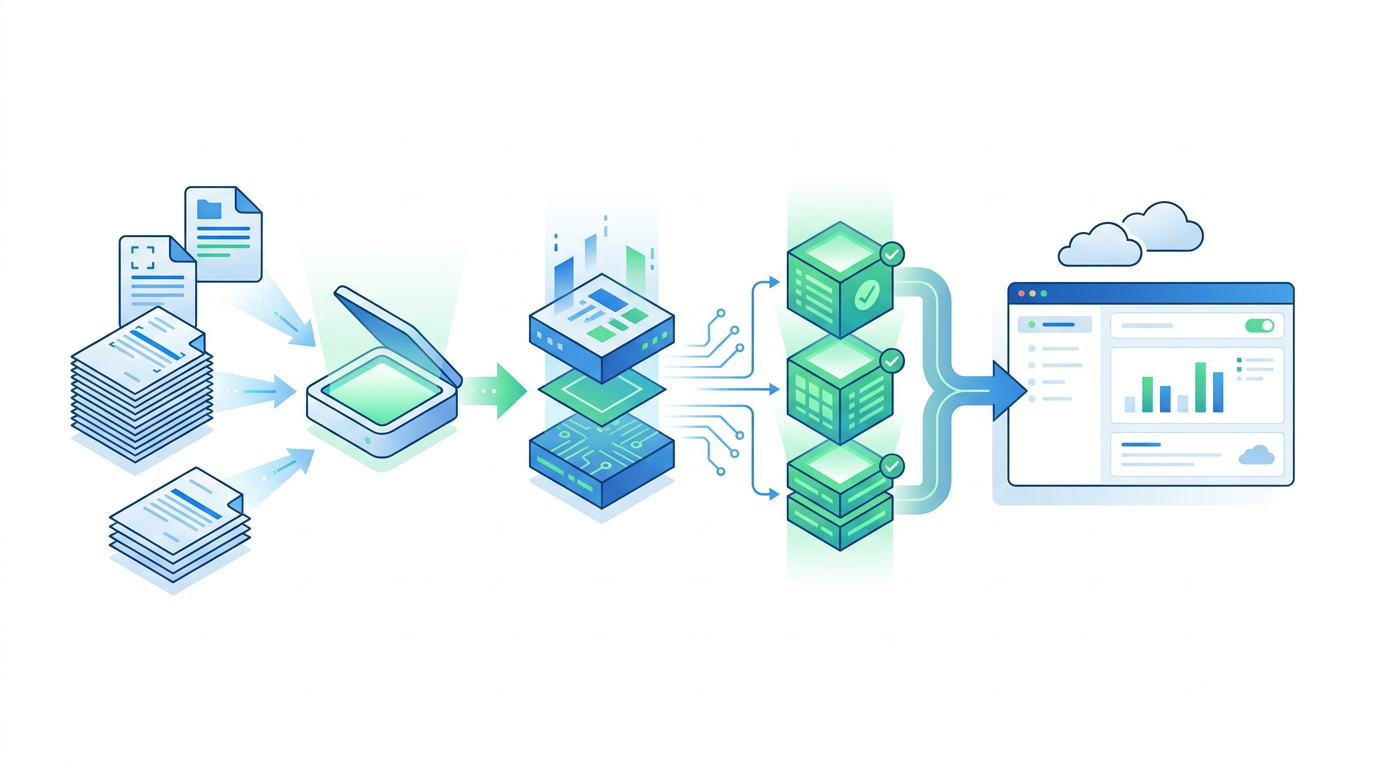
Tungsten Automation Capture (formerly Kofax Capture) is one of the most widely deployed document capture platforms in regulated enterprises across financial services, healthcare, insurance, and government. If your organization is running it today, you already know what it does well: reliably ingesting documents from scanners, email, and portals, applying OCR, and routing output into your ECM or line-of-business system.
What's less clear, for many organizations, is whether they're getting everything they should out of the platform and where DAS fits in when the answer is no.
Tungsten Capture handles the front end of the document processing pipeline. Documents enter the system from a variety of sources, whether it’s high-volume production scanners, MFPs, email inboxes, web portals, and fax. The platform applies OCR to create searchable text, uses recognition profiles to classify and separate document types, and extracts index values for routing and storage.
For organizations processing thousands of documents per day, Tungsten Capture provides the reliability and throughput that manual handling simply cannot match. It integrates with downstream repositories, including OpenText, IBM FileNet, SharePoint, and line-of-business applications, and supports complex, multi-step capture workflows across distributed locations.
The gap isn't in what Tungsten Capture does, it's more in how it's configured. In most production deployments the platform is set up to solve a specific, bounded problem: capture this document type from this source and send it to this folder. That configuration often gets the job done.
What it doesn't do is adapt. When a supplier changes their invoice layout, the extraction profile breaks. When a new document type enters the workflow, someone has to build a new recognition profile from scratch. When exception rates creep up over time, there's no automated mechanism to detect it, only downstream complaints when documents are misrouted or data fields come back empty.
For organizations running mature Tungsten deployments, this maintenance burden is a recurring cost that's easy to underestimate. The platform is stable. But stability and optimization are not the same thing.
DAS has been implementing and supporting Tungsten Automation (and Kofax before it) for over a decade. Our practice covers the full lifecycle of a Tungsten Capture deployment, from initial implementation through ongoing optimization and managed support.
Specifically, we help organizations with:
You don't need a crisis to have this conversation. The organizations that get the most value from an outside engagement are usually ones where the platform is running, but not running as well as it should be.
If any of these sound familiar, it's worth a call:
These are exactly the situations DAS was built for. We know where Tungsten Capture breaks, what causes it, and how to fix it.
Whether you need a targeted exception audit, a full platform upgrade, or an ongoing support arrangement, we scope it clearly, agree on the deliverable, and deliver it.
Most engagements start with a focused assessment: we map your current capture configuration, review your exception data, and identify the specific changes that will produce measurable improvement. From there, the path forward is your choice, whether it’s a defined optimization project, a phased upgrade, or a managed support arrangement.
If you're running Tungsten Automation Capture and want to know whether your deployment is performing the way it should, we're happy to take a look.


